Sunday, July 01, 2007

Second Thoughts

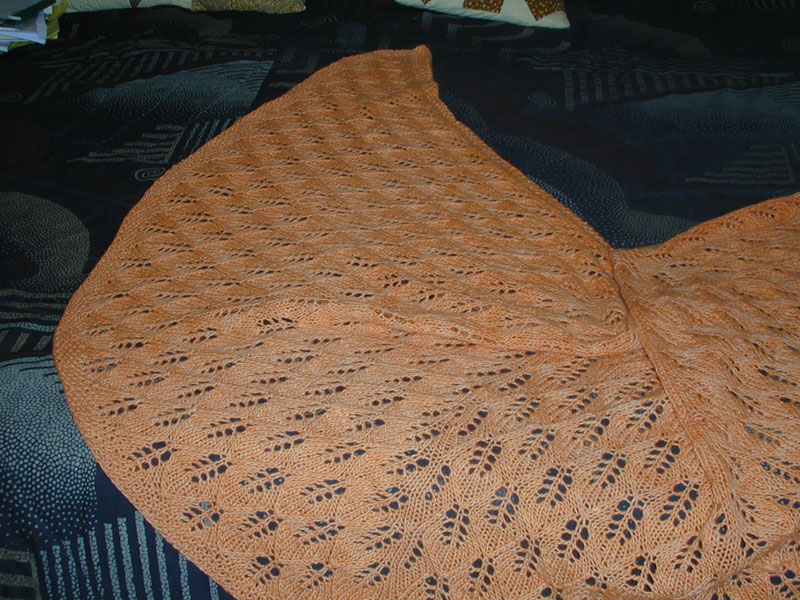
This morning I finished Clue 1 of Mystery Stole 3. I liked the way the swatch knit up on #4 needles, but I am wondering if the fabric isn't a bit too loose now that the first 99 rows of the actual pattern are finished. Since lace always looks really crummy before it is blocked, it is hard to tell for sure. There is time for a do-over before Clue 2 is released next Friday, but do I really want to do that??

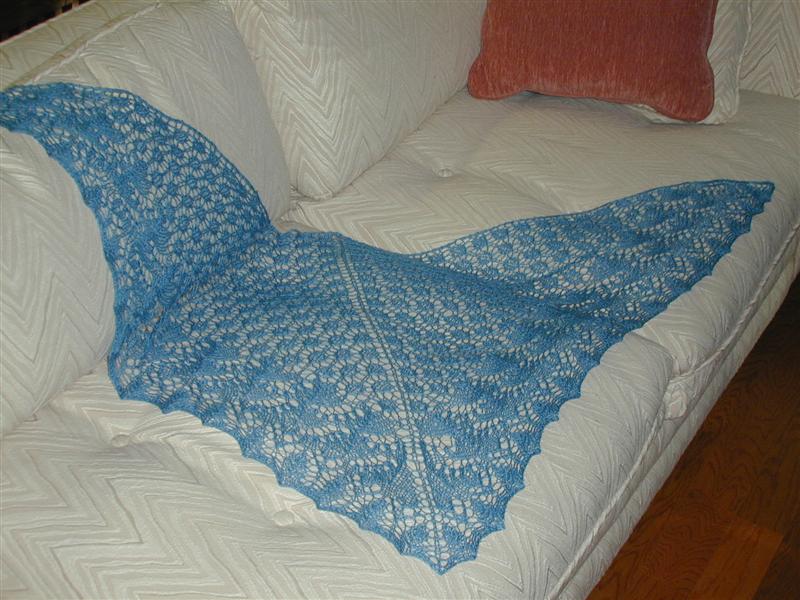
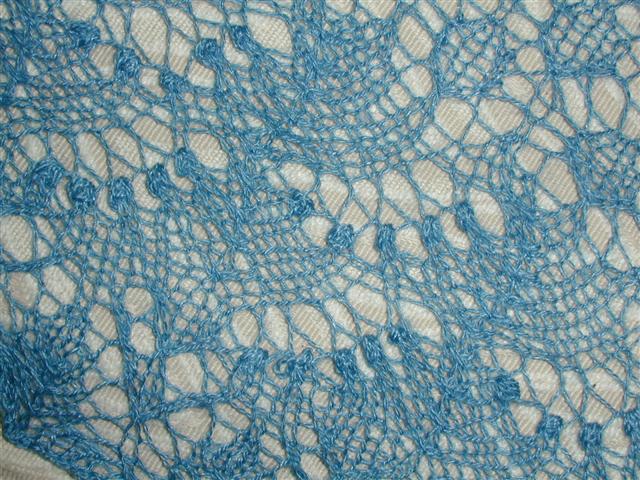
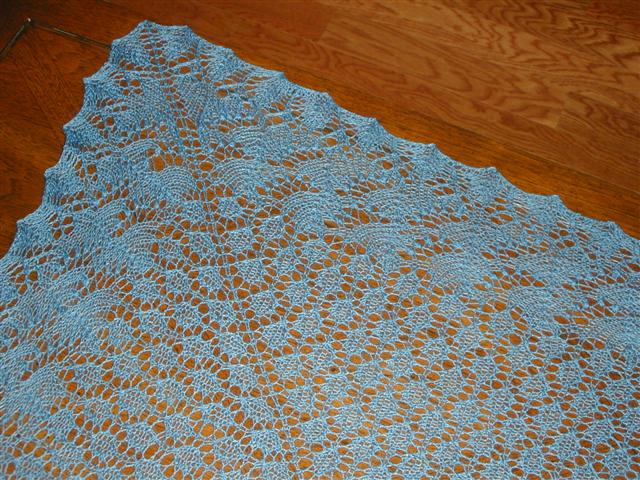
On another front, the beginning of MS3 coincided with the end of Icarus. I will always think of this as my "Florence shawl," since most of it was knit during the far-too-many hours in airports and on airplanes on the way to and from Florence last month. This was a wonderful project for traveling, because the yarn squishes up to almost nothing and can be tucked away into a corner of a purse, and the pattern for most of the shawl is simple enough to memorize. (I have to confess that the more complicated charts were done at home after the trip and could never have been done on an airplane.)

Pattern: Icarus Shawl by Miriam Felton, Interweave Knits, Summer 2006
Yarn: Jaggerspun Zephyr - Aegean blue, just under 100g
Needles: Addi Turbo US #5
Size: 80" across the top; 37" top to bottom

I finally got my invitation to Ravelry this week. What a fabulous site! I have started entering a few projects in my notebook, but mostly I have been browsing. It was nice to see how other people's Icarus shawls and MS3 beginnings turned out in other yarns and colors, and the site is set up in such a way as to make that easy to do. I wish Jessica and Casey much luck with this endeavor.

Friday, June 29, 2007

Ready, Set, Go...

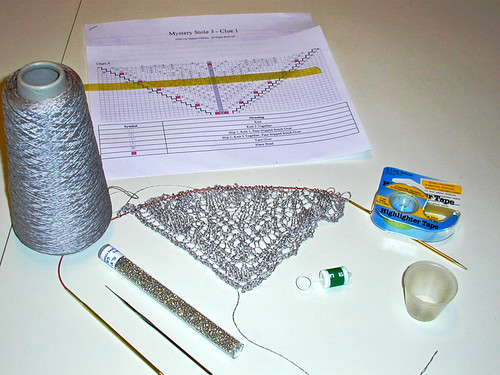
Today the first clue for Mystery Stole 3 was released. I was ready... yarn purchased, swatches knit, beads ordered, tools lined up.


New tools for this project include new Addi Lace Needles, a crochet hook with such a tiny hook that it is practically invisible, and highlighter tape.

The Addi lace needles have lovely sharp points, but they are not so slippery that the silk yarn slides off promiscuously. So far, they seem perfect for this project.

The #14 crochet hook looks like something you might find on the dentist's tray. The hook is so tiny that it is nearly impossible to see with the naked eye. It has to be that small to fit the holes in the beads. Fortunately, it is possible to do this by feel rather than by sight!

The other new item, which I had read about but could never find locally, is Highlighter Tape. It is wonderful for lace charts – just put a strip of tape above the line you are knitting, and move it up as you knit. It is far superior to my previous solutions: Post-It notes, strips of paper held with a paper clip, and even magnetic strips on an old metal document holder. The tape comes in several colors, and it is easy to move when you want to move it, but it sticks well when you don't want it to move. I had looked for it locally but never found it, and I finally ordered it online. Highly recommended!!

The beads are beautiful, but they are tiny (size 8/0), silver-lined clear glass. I haven't figured out how to handle them without dumping them all over the floor... it happened once, though fortunately I had put a few of them in a little plastic medicine cup, so I didn't lose too many. Maybe some kind of little mat would work better than grabbing them from the cup with the hook – this is my first experience with beads, and some experimentation may be in order.

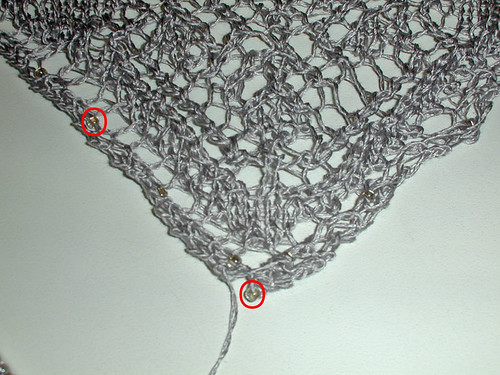
I did swatch for this project, but I knit the swatches before the beads arrived. I chose these beads to create a subtle effect against the silver-gray silk, but I am now wondering if the effect is too subtle. (They don't show up well in the photo, but they don't show up well in real life either!) I also have some larger (6/0) beads that I ordered by mistake, and I am considering using those in the center section of the stole. More experimentation in order...

This stole, like Mystery Stole 2, promises to be a challenging project but extremely engaging. It is compelling to knit "just one more row" to see how the design is evolving, even when there are other things to be done.

The first few rows did not get off to a good start. I was having a lot of trouble maneuvering the two ends of the needle, the yarn, the crochet hook, and the bead without dropping any of them. O to be an octopus! It is getting easier, but another hand or two would still be helpful.

Thanks, Melanie, for the opportunity to be part of this community of over 3000 knitters from all over the world working on a project that will be interesting to knit and will result in learning new techniques... and will, undoubtedly, be beautiful when finished.

Thursday, June 21, 2007

Shopping in Florence

Anyone who knows me knows that shopping ranks on my list of enjoyable activities down around cleaning and ironing. But occasionally shopping (or, more accurately, browsing) can actually be enjoyable – especially in a foreign country, when you don't actually have to buy anything.

As a knitter, I sought out the two yarn stores in Florence. One of them, Campolmi Roberto Filati (not far from the Duomo), is actually a manufacturer, with a large array of colors in several different fibers, mainly cottons, acrylics, and some wool, though the wool didn't feel especially soft. I may have been overtired and overheated by the time I got there, so I didn't find anything especially compelling, but it looked like there were some real bargains, and I would definitely check it out more carefully on another visit.

On the other hand, one of the highlights of my week was the visit to Beatrice Galli's shop in the Oltrarno area, right on the "other" side of the Ponte Vecchio. The charming Beatrice has run her shop for 40 years, and despite her claims of not speaking English, she has customers from all over the world. I got there just as she opened in the morning and was the only customer, and she patiently endured my primitive Italian for over half an hour as I looked, fondled, and lusted after her gorgeous skeins in wool, silk, and blends. I didn't buy anything, but I promised to return in October with some knitting friends and a clear idea of patterns and quantities – and a spare suitcase.

On another morning, I went to the Mercato Centrale, the large market near San Lorenzo, which is truly a feast for the eyes. This 19th century building houses a huge array of butcher shops, cheese shops, and stalls selling prepared foods, dried mushrooms, pasta, wine, and olive oil. The upper floor has stall after stall of fresh produce, with the aroma of basil wafting throughout. (Click on the picture for a brief slideshow.) It was hard not to be seduced by the beauty of the various displays and to walk out empty-handed. Of course, I didn't. After tasting several varieties of olive oil and aged balsamic vinegar, I bought a bottle of each... but I did manage to leave behind the fresh black truffles at €25 each. And then the cheese – after tasting several samples of parmegian reggiano I bought a large wedge that weighed in at over 2 kilos. When the woman behind the counter asked which I wanted, I said "non troppo grande, non troppo piccolo," but when she weighed them I kept thinking that bigger would be better, since it keeps well, and I would be sorry later if we used it up too quickly.

Even the little markets on quiet side streets provided pleasant surprises. A close look at the purple flowers reveals that they are artichokes! Inside the little shop we succumbed to a basket of tiny fraises des bois, the intensely flavored wild strawberries that are almost impossible to find at home.

And then there were all the jewelry shops on and near the Ponte Vecchio. My favorite time there was in the morning, as the shops were just opening. Other times it was so crowded that there was no temptation to linger!

Walking around Florence is a treat. The markets, the amazing artwork, the huge centuries-old palazzos, the nice little shops in unexpected places on side streets... You can even see art in the making – sidewalk artists working hard to create copies of masterpieces for the pennies people throw into a basket as a donation. This artist was working all day. When we walked by in the morning, he had just finished the head, and in the evening he was still working on the almost finished picture – the same Leonardo da Vinci that was on the wall in our hotel room.

Tuesday, June 19, 2007

A week (almost) in Florence

It was really the Trip from Hell. A late departure from Newark, missed connections, cancelled flights, lost luggage. After 26 hours (and an unexpected 4 1/2 hour bus ride from Milan to Florence), we finally arrived at the hotel. I kept asking myself why I thought it was a good idea to accompany R on this trip. Art and history only get you so far!!!

After the nightmare of the trip, the taxi dropped us off on a dark little street close to the Duomo. There was a scary moment when we thought the hotel didn't really exist, but we found the buzzer and someone did open the huge door to let us in. Then we saw it... a little sign that said "Hotel Centrale on the second floor." Can you imagine anything I would like seeing LESS than a huge flight of stairs at that point? Not only stairs, but Florentine stairs. This is a former palazzo, and each flight of stairs is about a mile up. (And in Europe "second floor" means two flights up from the ground level.) Of course we had no suitcases to carry, so it could have been worse! I almost expected the hotel to say "You were so late that we cancelled your reservation" – but for once everything was in order, and we were shown to our room, which was simple but pretty and spotless, with a copy of a Leonardo da Vinci painting on the wall. By the way, I would recommend this hotel highly.

Despite the crowds (June already being peak tourist season), despite the heat, and despite the horrible time we had getting there, Florence is still a wonderful city. It is small enough that you can walk everywhere, though the cobblestone streets can be hard on the ankles. R was busy with the conference every day, and my job was to play tourist. It wasn't hard to do – it was just hard to narrow down the choices!

The conference seems to have been a big success for the participants, quite a few of whom R has known for decades, and some of whom (along with their wives) I met many, many years ago. One day I spent wandering around the city with three of the wives, one from Argentina who has lived in Italy for many years, one from Belgium who has lived in Switzerland with her Scottish husband for many years, and one Belgian. The common denominator, of course, was English, and all of them speak it fluently, so I felt linguistically inferior but enjoyed the fact that they could all communicate with me anyway. I tried to rejuvenate my somewhat pathetic Italian, and it was really a pleasure to hear the music of the language all around me, even when I can't understand what people are saying.

My obligatory visit to the Uffizi was, as expected, delightful. With a reservation I was able to walk right in at the appointed time and stroll leisurely through, though I was told that without a reservation there would be a 3-4 hour wait to get in. Unfortunately, the museum (like Florence in general) suffers from far too many tourists per square meter. There were some rooms where it was impossible to see the artwork, though patience paid off – usually after a wait of a few minutes the crowd would disperse and I could catch a glimpse before the next surge.

One night there was a lovely banquet at a restaurant in one of Florence's many, many converted palazzi, and the food was wonderful. The guest of honor, whose 65th birthday was the excuse for holding this conference, seemed truly touched by the very nice (and brief, and in one case extremely witty) speeches made about him. Another night, also as part of the conference, there was a concert of piano music for 4 hands. We met two professors from Florence for dinner first ("American style," a.k.a. unfashionably early) at a little out-of-the-way trattoria with wonderful authentic Florentine food. A day of fabulous art, food, and music... what could be better?

Our last three nights we had dinner in three different restaurants. Twice we went with Italians to little trattorias we would never have discovered on our own, and the food was excellent at both. The other night we went back to Acqua al Due and it was just as wonderful as we had remembered. We had "assaggio di primi" -- a tasting of 5 different kinds of pasta, and then shared bistecca fiorentina al aceto balsamico, a steak with balsamic vinegar. We then shared an "assaggio di dolci" -- tasting of 5 different desserts -- which we would have skipped except that the couple with us was an evil influence!

R was busy at the conference every day except Sunday, when we did a lot of walking and visited both the Museo dell'Opera del Duomo (see the amazing choir loft by Della Robbia here) and the church of Santa Maria Novella, which has some phenomenal artwork by many of the Big Names in Italian Renaissance art like Brunelleschi, Masaccio, Filippino Lippi, Ghirlandaio, etc. Our favorite is the Lippi fresco of St. Phillip driving the dragon from a Roman temple. It is a stinky dragon, and you can see people holding their noses, and the king's son actually faints from the smell. You can see it here. The decision of what to do that day was made easier by the fact that most museums are closed on Sundays, and the churches are open to tourists only in the afternoons. In the late afternoon we walked over to the Piazza della Signoria to take a last look at the wonderful statues out in the open, including a copy of Michelangelo's David and my favorite, Giambologna's amazing Rape of the Sabine Women. Nearby is a Cellini bronze of Perseus holding the head of Medusa plus a variety of other really gory statues.

All in all, it was an interesting -- though far too short -- visit. The conference attendees all seemed to agree that it was an exceptionally good conference, and the spouses had no problem keeping ourselves entertained. It may be the City of Aching Ankles, but it is also a city that is imbued with the history of art, the history of science, and fabulous food. I can't wait to go back. (But maybe on a different airline next time. After all the trouble they gave us on the way to Italy, Continental/Alitalia also managed to lose one suitcase and damage another one on the way home.)


Thursday, May 24, 2007

Itty Bitty Raglan Cardigan

After all the discussion about whether boy babies could possibly wear a multicolor sweater with some shocking pink in it (see previous entry), I decided that it would be better to use the yarn in question for some other project and make the Baby in Question something completely different. Plan B was a very cute pullover with a big question mark in front, but I wasn't happy with the way it was knitting up in the reddish-orange I had chosen (thinking "cardinal" meant red) and black. Fortunately, I did the front first, so frogging it wasn't particularly painful. So on to Plan C, a generic raglan cardigan, with black uneven stripes and edging to add a little interest. VoilĂ :

Pattern: Baby Cardigan by Joy Jannotti, Size 12 mo.
Yarn: Mission Falls 1824 Cotton, 4 balls (200g)
Needles: Denise #5US
Revisions: Added unequal stripes generated by Random Stripes Generator and contrast edging

Despite all the false starts, it is very nice, and I liked the feel of the yarn. I have an extra ball of the orange and the black, so I will have to buy more to have enough for another baby sweater, but it should age well in the stash for the time being. The yarn has a slightly nubby feel to it, which makes it a little more interesting than plain cotton – definitely something I would use again. And now I have a color card, so there shouldn't be any color surprises when I order more!

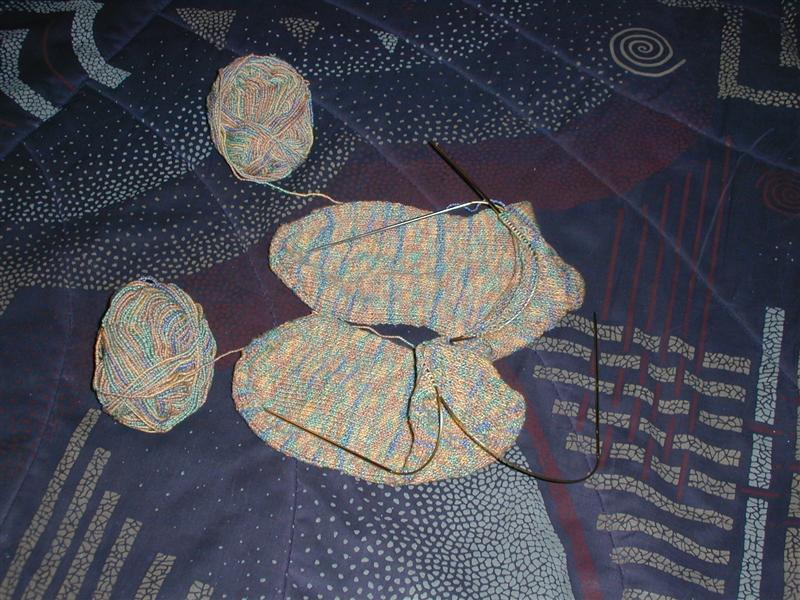
The day after finishing the baby sweater, I cast on new socks for DH. (It isn't as if I didn't have several other projects going at the same time, but nothing that was simple enough or small enough to carry around in my purse.) This is my third attempt at Crazy Toes and Heels socks:

No, this isn't what it looks like... it is the toes of two socks knit simultaneously on two circular needles, according to the excellent manual by Mary Ann Beattie, aka "Queen Kahuna." Each previous time I had trouble getting started, but once I got going, they weren't at all difficult. This time I expected no trouble at all, given that it was the third time, but I still had to frog and restart several times. I'm still not sure why the tippy toes look a little strange. Maybe it will take 4 or 5 pairs before getting it right. At least, doing it this way, they both come out exactly the same!

The endless edging on the Garden Shawl continues... Why am I not comforted by the fact that I passed the half-way mark???

Thursday, May 10, 2007

Seeing pink

First, a disclaimer: I hate pink and I have always hated pink. Even as a child, I wouldn't have been caught dead wearing pink. It's okay in a rose or a tulip, but not on me. And, having had two sons, it was never an issue in terms of clothing in this household.

I recently encountered a skein of beautiful, soft merino sock yarn from Interlacements that someone had given me. It has a variety of intense colors, including dark blue, green, purple, orange, brown, and.... shocking pink. (Okay, the pink was there, but it looks nice as an accent among other colors.) It seemed too pretty to waste on socks and the 500-yard skein enough to make a baby sweater. I found a pattern for a V-neck pullover that seemed perfect, and the knitting began. And then it happened – as the sweater got bigger, the pink began to take over. I took an informal survey and asked 7 women if they would put this sweater on a boy, and 5 said "yes, it's beautiful;" one said "no way!"; and one said that her daughter would put it on a boy but her daughter-in-law wouldn't. So, given that the Baby in Question lives 7,000 miles away, and his mother's taste is really an unknown, and the yarn is too expensive to be stuck in a drawer and never worn, it is, sadly, on its way to the frog pond.

Plan B is the Quiz pullover from Mission Falls 1824 cotton. But instead of black and white, I decided to do it in red and black. Ordering yarn over the internet is always dangerous, and I should have learned my lesson a long time ago, but since there is no LYS near by, it is pretty hard to avoid it. The color I ordered was called "cardinal," and it looked red on my monitor, but the yarn that appeared looks more like a coral than a true red. Okay, coral is sort of orange, and that should be okay for a boy. So I started knitting. And something very funny happened. The "cardinal" started getting pinker and pinker. So now it isn't clear what to do. Maybe the lesson is to stick to Boring Blue for boys.

Friday, April 27, 2007

Second Heartbeat

No, this is not a reference to twins. It is my second Heartbeat Sweater. I enjoyed knitting the first one so much that I immediately started a second. The first one was a solid green, and I thought it would be interesting to do it in a variegated yarn as shown in the pattern photo.

The yarn was a real bargain from Smiley's Yarns for $1.50 per 50g skein. There was a lot of waste because of the scant yardage per skein (80 yds), and a lot of ends to weave in (ugh). It took 13 skeins, but the total weight of the finished sweater is only 550 g, which sounds like it should have been 11 skeins. And it is heavy – 550 g is nearly 1.25 pounds – I can only imagine how much it weighs wet! But it has a very nice feel and an interesting texture.

I do like the way the variations in the yarn emphasize the truncated diamond shape of the pattern.

Pattern: Heartbeat Sweater by Jill Vosburg, Just One More Row
Yarn: Filatura Lanarota Circus (85% cotton, 15% Acrylic)
Needles: Denise Size 5
Gauge: ~ 4 sts/inch
Yardage: approx. 1000 yds for 48" size
Modifications: unintentional slight contrast on sleeve edges, since I grabbed the wrong skein of yarn on the first sleeve and it didn't look bad, so I used the same skein for the second sleeve instead of frogging. It became a "design element." I thought about using the same yarn on the neck edging but chickened out.

Having knit this sweater twice, I am still mystified by the geometry. It is an ingenious design, and somehow it all works out to be the right shape for a sweater, thought there were times when I had my doubts.

And, speaking of doubts, here is the Garden Shawl from Fiddlesticks in its "amorphous blob" state. This is a scary time in the life of a lace knitter, when a huge amount of time has been invested and it isn't at all clear that the object of all this effort will look like anything but a lump when it is finished. And it isn't clear that it will ever be finished because the edging (knit perpendicular to the edge of the shawl) goes on and on and on...

Yesterday I had an odd Knitting in Public experience. On a whim I had decided to go to the Johnson & Johnson annual shareholders' meeting, something I had never done before. Since I had been warned to get there early to be sure to get a seat in the main ballroom and not have to listen to sound piped into one of several overflow rooms, I had stuck a pair of socks-in-progress in my pocketbook. I was happily knitting when an elderly gentleman sat down next to me and asked if he could put in an order for a pair. He turned out to be a retired J&J engineer who had worked in the division that made tampons (in the days when things were actually manufactured in NJ). Occasionally they had to reject spools of the extremely strong reinforced cotton string they used, and employees could take them home, so he gave some to his mother to use around the house. A few years later she showed him a tablecloth she had crocheted... from the rejected tampon string! He says he still has the tablecloth and chuckles whenever he looks at it.

Friday, April 13, 2007

Punishment and Reward

I must have committed some terrible knitting sin in the past to have earned the ordeal of knitting the Cotton Chenille Baby Sweater. In fact, it was so awful to knit with this yarn (Crystal Palace Cotton Chenille) that it took months to finish. Because of the texture of the yarn (thick and unstretchy) and the fact that I had to use size US #2 needles to get a decent fabric (despite the fact that the pattern called for #6 needles with this exact yarn), my hands would ache after knitting just a few rows, and it was hard to work up the energy to pick it up again. I finally realized that if I didn't finish it soon, the Baby in Question will have outgrown it, if she hasn't already! So here it is, not exactly as it was supposed to be, but at least finished:


It was much too hard to do the bobbles in the multicolored trim with the #2 needles, so I just did plain garter stitch. I hope the baby and (more important) her mother like it.

Note: if you are wondering why I used #2 needles, check out my blog entry on swatching for this sweater.

Immediately after finishing this sweater I cast on for a sweater for the soon-to-be new baby in the family. The Cascade Pima Tencel I used for this sweater was a total delight. My reward for suffering through the "chenille ordeal"??? It took only days to finish the sweater (based loosely on a pattern in The Yarn Girls' Guide to Kid Knits) and the hat (generic baby hat, no known pattern):

The hat was an afterthought, since there was a little of each ball of yarn left and it would be a shame to let it go to waste. The color combination is admittedly a little weird for a newborn, so I hope my daughter-in-law likes it. At least it was fun to knit!

Tuesday, March 27, 2007

Heartbeat Sweater

With a little trepidation I started a Knit-along for the Heartbeat Sweater from Just One More Row. One knitter mentioned a problem with the neckline being too wide and deep, and after my experience with the Sprinkle Lace Cardigan I wasn't anxious to deal with that again! But the pattern looked like it was easily adjustable, it seemed like a quick and easy knit (compared to the barely visible yarn for my current lace project), and there was even yarn in my stash that seemed suitable, so why not?


Pattern:
Heartbeat Sweater by Jill Vosburg, Just One More Row
Yarn: Filatura Lanarota Luxor D.K. (50% cotton, 50% Acrylic)
Needles: Denise Size 6
Gauge: 5 sts/inch
Yardage: approx. 1200 yds for 48" size

The construction of this sweater is very unusual. It begins at the center neckline and is knit outwards, with vertical side panels in garter stitch, and sleeves knit onto the side panels. The pattern is very well written, with a large number of diagrams – and thank goodness for those, because I had the whole front nearly finished before I could figure out how this bizarre shape was going to turn into a sweater! (I find that a certain amount of faith is sometimes necessary in knitting.)

Because of the design of the sweater, there are no exact measurements in the pattern – you have to take measurements (Jill recommends measuring a garment that fits you well), and from time to time there are reassuring comments like "Don't worry, the side panels will allow you to adjust the fit exactly to your size." It is possible to try it on as you go, so adjustments can be made at various points without major surgery (for yourself or the sweater).

Because I was concerned about the neckline, which is sometimes a problem with patterns written for smaller sizes and calculated proportionally for larger sizes, I followed the suggestion of one knitter in the Knit-along (I'm sorry, I don't remember who it was) and added a few extra increases on each side at the top, though it might not have been necessary.

The only other modification I made was to make the sweater a little longer than shown in the picture, so my yardage was more than the estimate for that size, even though the gauge was the same.

The Denise needles were perfect for this project, since at several different times you are instructed to slip stitches onto a holder or smooth string. With the Denise needles and several extra cables it is possible just to detach the needle tips, screw on a cap, and leave the stitches on a cable until you are ready to continue with that section. Then unscrew the cap, put the needle tip back on, and knit away.

Finishing is easy, since you use a 3-needle bind-off to join the sides. The one thing I found annoying was a seemingly endless array of ends to weave in. The truth is that I am spoiled – I have done a lot of knitting recently with yarn on cones (so there is no need to join yarn from separate skeins), and even when knitting with smaller skeins I generally use animal fibers that I can join with a spit-splice, and hence no ends. Since this yarn was a cotton blend in 130-yd. balls, there were lots of ends, and that is always my least favorite part of any project (aside from sewing pieces together).

I enjoyed knitting this sweater, I like the style, and I like the way it fits. So the only question in my mind is what yarn to use on the next one... maybe something variegated, like the one shown in the pattern photo.

Thursday, March 15, 2007

Reluctant Sweater Set

The problem with the Sprinkle Lace Cardigan's low neckline has been solved, thanks to the generosity and ingenuity of several knitters on two different knitting group lists who offered suggestions after my last post. Suggestions ranged from varying degrees of major surgery to adding additional edging to the neckline or just wearing something else under it. Probably the most clever was to lace ribbon all the way around the neckline (instead of just as a tie, as suggested in the pattern) to gather and pull it up. Since that solution required the least effort, I decided to try that first... but I had already started a matching shell with the remaining cone of yarn. So I now have a beautiful sweater set:


CARDIGAN:
Pattern: Sprinkle Lace Cardigan by Natalie Wilson
Yarn: 100% cashmere DK from Colourmart - color China Blue - approx. 400 gm
Needles: Denise US #8 and #7
Modifications: Additional crocheted edging on neckline; eliminated waist shaping on body but knit bottom 4" on larger needles

SHELL:
Pattern: based on Quick & Easy Shell by Kate Winkler
Yarn: 100% cashmere DK (see above) - approx. 180 gm
Needles: Denise US #8 and #7
Modifications: Added Sprinkle Lace pattern to match the cardigan

Here is a somewhat blurry picture of it on a reluctant model (but the only one available):

Despite all the crises, I am delighted with the final product. The advantage for me, the wearer, is that I get to feel how lovely and soft it is; everyone else just gets to see it.

I have learned a few lessons from this experience. One is to try on the item as y0u go. I didn't do that because I had allowed for shrinkage, and as long as the gauge was still on track I thought it would be okay. But that didn't allow for errors in the pattern or errors in following the pattern. If I had even tried it on just before doing the 3-needle bind-off at the shoulders, it would have been easy to make adjustments before assembling the whole sweater.

AND... I learned how to crochet!

Saturday, March 03, 2007

The good news and the bad news

The good news is that I have finished the lace sprinkle sweater. It is beautiful. The bad news is that I don't like the way it fits, and I'm not sure it's my fault.

As you can see from the photo, the neckline is too wide and too deep. After all, the purpose of a cashmere sweater is to keep you warm, not to show off one's assets! I don't know what went wrong – a comparison with the designer's photo (see previous blog entry) shows that the neck wasn't supposed to be low and sexy.

I already tried to compensate by increasing the edging around the neck. (Yes, I did figure out how to do a single crochet and half double crochet for the edging all the way around, and managed it quite nicely, if I do say so myself.)


The additional row of edging around the neck looks good, but it didn't solve the problem. It really needs a few more inches, so it's hard to imagine doing enough edging to fill in the gap. I'm open to suggestions!

The yarn, Colourmart cashmere DK weight, is fabulous. It was a pleasure to knit, and after the "tough love" treatment of washing in hot water and drying for several minutes in the dryer, it bloomed into something so soft that it is hard to be in the same room with it and not want to caress it. So it would really be a shame to let this sweater just hide away in a drawer, neglected.

Saturday, February 24, 2007

Today's project: Learn to crochet

Today I have to learn to crochet. I have finished knitting the Sprinkle Lace Cardigan and even sewed/grafted/wove the pieces together, a job for which I have so little aptitude that it is clear why I prefer knitting shawls to sweaters. The sweater is finished with a crocheted edging around the edges of the sleeves, bottom, and neck. And I don't know how to crochet.

[Why, I ask myself, did I buy a pattern that includes something as esoteric as a crocheted edging? Maybe because I was seduced by the picture of the sweater without realizing that it involved something I didn't have a clue about. Then, why did I start it, once saw the instructions? There are no answers to these questions. And here we are.]

It would be hard to overstate the mess I made of putting the pieces together. The fronts were the same length (thankfully I had knit them simultaneously), but somehow the fronts came out a little longer than the back, so there was some serious fudging involved in the seaming. Then there was the brilliant job I did of sewing the second front NOT to the back, but to one of the sleeve seams. A lot of unsewing went on to the accompaniment of some unladylike verbiage. (Is there a sewing equivalent of "frogging?" one wonders.) At least unsewing an 18" seam and redoing it takes a lot less time than having to frog and re-knit 18" of almost anything. As a result, the edging has to be less frustrating, even counting learning time for a totally new technique! I am armed with memories of my grandmother teaching me how to crochet a chain, plus the Vogue Knitting Crochet Basics, and will find out if it really is possible to learn how to crochet from a book.


On the Finished Objects front, there is one F.O. to report, the Gansey Pillow that was part of Elizabeth Lovick's Gansey Workshop. I didn't swatch (after all, it was just a pillow, so what difference did it make), and instead of a 12" pillow ended up with a 17" pillow. It was an interesting project, because reading a gansey chart is much different from reading a lace chart, and I actually like the finished product. I tried doing a little controlled shrinkage by washing it in hot water after it was blocked, but it wouldn't budge. I could buy an 18" pillow form instead of the loosely-fitting 16" form it currently occupies... we'll see. I still have to figure out how to close the back, whether with buttons or Velcro, or just let the overlap do the job. It might have been simpler if I'd followed Liz's instructions and put in buttonholes, but that would have been too easy.

The Shetland Garden shawls proceeds apace, but no pictures yet. And for a quickie trip to Florida to visit my mother (two hours in the airport and 3 1/2 hours in the plane each way) I started the Lady of the Forest wrap in some beautiful alpaca, which unfortunately shed all over my black clothes, but it helped to pass the time and divert my attention from the extremely unpleasant conditions of modern air travel.

And now to learn how to crochet...


Wednesday, January 24, 2007

Shetland Garden Shawl

When I saw this pattern I knew it had to jump to the head of the To Do list, and I knew exactly which yarn I wanted to use... the first cone of cashmere I bought from Colourmart, which has been quietly sitting and waiting for the perfect project. Here it is:

The photo doesn't really do it justice... it was hard to get the whole shawl into the picture, and the lighting wasn't ideal. Here is a closeup:


Pattern: Shetland Garden Faroese Shawl by Sivia Harding
Yarn: 4-ply Cashmere from Colourmart, approx. 120 gm
Needles: Addi Turbos size US 5
Blocked size: 26" long at center back, 31" from neck to tip at center front

Sivia Harding describes the shawl as "a lacy garden of delights: marguerite daisies, Shetland ferns and Shetland leaves fall gracefully over the shoulders, while rose trellises adorn the bottom border." It is knit from the center top down, and the Faroese shape lets it sit gently on the shoulders without slipping off. It was a pleasure to knit. The charts are easy to follow, though I admit to having blown them up to see them better.

And then there is the yarn. On the cone, it looks more or less like a thin twine you might use to tie up a box. But the Colourmart instructions (and the advice of other users) warn you that it contains oil from spinning and that the finished garment should be washed in HOT water in dishwashing liquid and then... get this... put on low heat in a clothes dryer for a few minutes before blocking. I had done that with a swatch, and the metamorphosis was amazing! Nonetheless, washing a finished object in very hot water was nerve wracking, and I don't think I was able to breathe while it was in the dryer. But when it came out of the dryer, still a bit damp, I could already see how incredibly soft it had become, and blocking did its usual magic on the lace design.

Thank you, Colourmart, for this amazing yarn, and thank you, Sivia Harding, for your beautiful design.

Saturday, January 13, 2007

Travel Knitting

For our winter getaway trip to Panama and Costa Rica it was hard to know what knitting project to pack. It had to be
  • small enough to be portable
  • light-weight so as not to be uncomfortable to handle in a warm environment
  • interesting enough to work on in airports, on long flights, and during "down time"
  • simple enough to knit while enjoying scenery, chatting, or watching a movie
After a few false starts I settled on the Lacy Moebius Scarf, using leftover Zephyr laceweight yarn. It met all the above requirements, and it turned out to be the perfect travel project. I swatched and cast on the day before we left home, and finished the last row on the (seemingly interminable) plane-ride home. The only thing left to do was the Kitchener stitch to join the ends, and since I couldn't remember how to do that, the finishing had to wait until our return. Here it is:

Pattern: Lacy Moebius Scarf by Mary J. Saunders
Based on: Roman Stripe pattern from Barbara Walker's Second Treasury of Knitting Patterns
Yarn: Jaggerspun Zephyr laceweight, Aegean Blue, approx. 40 gms
Needles: Addi Turbos #US 3
Modifications: Slipped first stitch of every row
Finished size: 15" wide by approx. 30" around. (I should have measured it before joining the ends together!)

I really enjoyed knitting this scarf. The pattern is simple, with a 7-row repeat, and easy to memorize. Zephyr is delicious to handle and squishes up to practically nothing, and so it was perfect to stick in a pocketbook or backpack. I know the moebius will be a staple of my winter wardrobe, maybe even indoors, now that winter has arrived in earnest.

More about the trip in a few days when I get the photos together...

Saturday, December 09, 2006

A sad tale of scratchy yarn

Recently I purchased some beautiful-looking hand-dyed New Zealand wool on eBay. When it arrived, I didn't immediately notice that there was anything strange or unpleasant about it, and my friend Clare kindly wound the skeins into balls for me. It was only about two weeks later, when I started swatching for a shawl, that I realized that it had an awful, scratchy feel. I wasn't alarmed right away, because I have had experience with cashmere that had a sort of stiff feel but became incredibly soft and drapy after the oil from spinning was washed out.

This time, though, washing didn't help. The washed swatches were scratchy and stiff. I wrote to the vendor asking for advice, and also posted a query to the Knitlist. Several suggestions were offered, including a long (overnight) soak in a solution of white vinegar, fabric softener, or hair conditioner. I tried them all. The final result? Stiff scratchy swatches. I have over 1,000 yards of this yarn and was ready to write it off, when several Knitlist members suggested using it for felting. So instead of a shawl, this yarn has a tote bag and maybe a hat in its future.

On a happier note, I have finished my first pair of socks! They look a bit lumpy in the photo, possibly because they haven't been blocked. (But then, I don't plan to block them... they will block themselves on my feet when I wear them.) Because of my big feet, the only socks I wear are men's black synthetic socks, so it will be really strange to have something with color on my feet!

Pattern: Based on Queen Kahuna's Crazy Toes and Heels
Yarn: KnitPicks Dancing – 41% Cotton, 39% Wool, 13% Nylon, 7% Elastic, 2 skeins with a little left over
Needles: Addi Turbo US #1 (both socks knit simultaneously on two circulars)
Pattern choices: Regular toe, slip-stitch heel, K4P2 ribbed cuff

The second pair of socks is already on the needles, and I have to confess that even on the second pair I had to frog (but only once) before I got the toe right. It isn't hard, it's just confusing, until you get into the rhythm of turning the needles properly. This pair is for my husband, and they will be just as long but smaller around the calf, so I should be able to make the cuffs longer. I always wondered why people would go to the trouble of knitting socks, since they are tucked inside shoes and generally unseen, but now that I've done it once I can see doing it again. And again. And again.

Tuesday, December 05, 2006

Alberta finished!

I have a new favorite shawl, Alberta. It is my second Faroese shawl from Myrna Stahman's Shawls and Scarves, and it is destined to be worn as often as the first. It is warm, soft, and very pretty.


Pattern: Alberta by Myrna Stahman, in Stahman's Shawls and Scarves
Yarn: Hand-dyed Merino wool from Uruguay, purchased from 100purewool on eBay, single ply worsted weight, approx. 1200 yards; color Mamao
Needles: Denise size US 10 1/2
Blocked size: Length 32" (center back) x 88" (wingspan)

The Faroese shawls have a very nice shape that sits easily on the shoulders without sliding off. The GS Gracie I made a few months ago has become a staple of my wardrobe – I slip it into my tote bag and carry it everywhere, just in case I'm cold (a far too frequent occurrence). Brenda Dayne of Cast On says "If you're cold, put on a sweater... That's what they're for." I would add to that "If you're cold and already wearing a sweater, put on a shawl... That's what they're for."

Saturday, November 25, 2006

Swallowtail Shawl

The Swallowtail Shawl is complete – and several weeks before the deadline! It is a Chanukah gift for my daughter-in-law, who said she liked the picture in Interweave Knits, where the pattern was published. I hope she likes it when she sees it in finished form – and actually wears it! The nupps drove me crazy, but otherwise it was a delightful pattern to knit and went very quickly. As usual it looked like a total blob before blocking, and then metamorphosed like the caterpillar to the eponymous butterfly.

Pattern: Swallowtail Shawl by Evelyn A. Clark, Interweave Knits, Fall 2006
Yarn: Jaggerspun Zephyr, Aegean blue, approx. 30 grams
Needles: Addi Turbos size US 5
Blocked size: 48" x 25"


I eventually cheated on the nupps, but after blocking they are practically indistinguishable from the real ones at the beginning. So if I do this pattern again (which is a distinct possibility) I will definitely do them as Sl2, P 3 tog, Pass slipped sts over, instead of P5 tog. The only difference is that this time I won't feel guilty about it.

What is it that is so addictive about lace knitting??? I have my second (Myrna Stahmann's) Faroese shawl on the needles, in another warm squishy worsted wool from Uruguay, but after finishing the Swallowtail I have a longing to start any of the 6 or 8 other lace patterns sitting in a stack on my desk. Oddly enough, two of them are by Evelyn A. Clark, the same designer who created both the Swallowtail and the Pacific Northwest Shawl. I never even noticed who the designer was until after I had bought the patterns. There is a je ne sais quoi about her patterns that must speak to me.

Oddly enough, in the middle of all this lace knitting, I suddenly got to urge to learn how to make socks. Could it be the onset of cold weather? The fact that "bought" socks never fit me properly? The fact that the only socks that do fit are boring? Or the fact that every other knitter in the world is talking about socks and I don't have a clue how to make them? Or all that beautiful sock yarn that suddenly seems to be available? [The correct answer is "all of the above."]

With the plethora of sock patterns available, it was hard to know where to start. But one thing was clear... that I would have to do a toe-up pattern, to make sure I wouldn't run out of yarn. (Why is it that sock yarn is generally sold in skeins large enough for an average sock? Another case of discrimination against ampleness?) Finger-less gloves are one thing, but the toe-less sock is an idea whose time has definitely not come! I had been looking at the Queen Kahuna approach, which made a lot of sense, since you knit both socks together on two circular needles. So this week I took up my new size 1 Addi turbos, two skeins of Knitpicks Dancing, and Page 1 of Queen Kahuna's book.

The less said about the first three attempts the better! On three different days I started, reading every word of the extremely explicit instructions and studying the many diagrams, only to finish the session by frogging the whole thing. On the fourth day, though, it came together, and I made it past the toe section and up thorough the foot. Yesterday, when everybody else in New Jersey was at one mall or another, I tackled the heel section, and despite struggling with a few of the instructions and somehow being off by one stitch in the slip-stitch section of the heel, got to the point of starting the cuff. I took a deep breath and slipped one onto my foot and ... (drumroll, please) ... it actually fits!

This process is not for the dimensionally challenged. You are juggling two socks, with two balls of yarn, on two circular needles (the front of each sock on one needle and the back on the other). When turning the work at the end of each row you have to be careful to (1) knit on the correct part of the sock using (2) the correct needle end and (3) the correct ball of yarn. It sounds easy, but on several separate occasions I noticed that I had knit onto the wrong needle (easy enough to undo) or, worse, joined the two socks to each other. I now know to check after each round that they are NOT connected, so in the worst case I just have to tink a row. In the long run, though, this method has distinct advantages: the socks will come out the same (barring some horrible mistake) and, even better, they will be finished at the same time, thereby avoiding the Second Sock syndrome that plagues so many knitters. The only down side is that one of the big arguments for knitting socks is their portability. The two-at-once approach makes them somewhat less portable. But that seems to be a small price to pay.

Friday, November 17, 2006

Weekend at the Frog Pond

I spent this past weekend in central Pennsylvania with 5 other members of the A-K knitting group. It was a delightful weekend way out in the country (as in chickens, goats, and horses) – a nice change from central NJ – in good company. We spent the weekend knitting, talking, eating, and laughing. One of the highlights was going through a huge stack of old knitting magazines and practically rolling on the floor in hysteria at some of the designs.
The others were working on a variety of interesting projects, while I spent most of my time frogging. My first sweater after my 20+ year knitting hiatus was an Einstein jacket in Noro Kureyon. It looked absolutely terrible on me – I didn't realize that the stripes would be so pronounced, and the vertical stripes didn't counteract the effect of the horizontal stripes. It has been sitting in a lump, never blocked and ends never woven in, waiting for a reincarnation. The yarn finally decided that it wanted to be a knitting bag, so I took it along with an unfinished hat and a shawl to work on over the weekend. What a project! Because of the construction of the jacket, which is knit in one piece, with top part knit perpendicular to the bottom, it is extremely difficult to unravel, and seemed to take forever. I was beginning to think it was going to take as long to frog it as it did to knit it.

Back on the home front, I finished the Swallowtail shawl, which is blocking. Despite the torment of the nupps, it is a lovely design. I'll take a picture when it finishes trying.

On another note, the Reluctant Penguin was just accepted into the Knitting Blogs webring!

Wednesday, November 08, 2006

Pacific Northwest Shawl

This pattern seemed to call my name the first time I saw it. Since I had never knit lace more complicated than a simple scarf, it was quite a while before I tackled it. Here it is:


Pattern: Pacific Northwest Shawl by Evelyn A. Clark
Yarn: Jaggerspun Zephyr, peacock, approx. 75 grams
Needles: Addi Turbos size US 6
Blocked size: 36" x 72"
Modifications: Omitted I-cord edging along top edge (because I have never done I-cord before and couldn't figure out how to do it)

This shawl was a pleasure to knit, and it went very fast. The Zephyr yarn has a wonderful feel, and the pattern was generally easy to follow. The only problem was the small size of the charts, but thanks to the wonders of modern technology I was able to blow them up to a size large enough to see. It isn't quite as large as it should be, but blocking was a problem – it didn't fit on my blocking board and even the bed in the spare room was iffy. I may try re-blocking it, if I can figure out where to do it.

Here is another view:

By sheer coincidence, my next project was designed by the same designer. It is the Swallowtail Shawl from the Fall Interweave Knits. Here it is about 3/4 done:

It doesn't look like much, but then lace always seems to look like an amorphous blob before it is blocked.

The problem with this pattern, in a word, is... NUPPS. Nupps are bobbles made by knitting several stitches into a single stitch, and then on the next row purling them all together. In this pattern the nupps are formed by K1 YO K1 YO K1 in a single stitch, and then on the next row doing a P5 tog. Ouch! I don't consider myself a particularly tight knitter, but getting the needle through 5 stitches at a time is incredibly difficult. I even bought Bryspun needles, having read that they have sharper points than Addis, and in fact they do... but not sharp enough! The first part, the budding leaf pattern, was uneventful, and it seemed to be going well. Then came the next section... NUPPville! The lily of the valley pattern is very pretty, but almost led me to frog the whole thing.

Fortunately, there is a Knitalong for this shawl, and several knitters shared tips for dealing with nupps. The one that worked best for me was to slip 2, P3 tog, pass the 2 slipped stitches over. There is apparently a slight difference in how it looks at the end, but in my case it was either "cheat" or quit.

Thank goodness for internet support groups!

Wednesday, November 01, 2006

Shetland Tea-ish Shawl Finished!

This is absolutely gorgeous (if I do say so myself). It took a long time to knit, and then there was the saga of the missing blocking wires (which, in the end, I didn't use), but here it is...


Original Pattern: Shetland Tea Shawl by Dale Long in A Gathering of Lace
Yarn: Handpainted 100% Cashmere from Mystical Creation Yarns, approx. 4 oz. (~1625 yds)
Needles: Addi Turbos size US 4
Blocked size: 48" diameter
Pattern modifications: Open circle instead of circular pi shawl; substituted Madeira and Diamond pattern (fromHeirloom Knitting) for Diamond Madeira pattern; added additional repeat of Horseshoe before the edging

The yarn is absolutely gorgeous, but was so fine that it was like knitting with dental floss. As a result the shawl is somewhat smaller than I would have liked... but I just couldn't bring myself to face another increase round to over 1000 stitches! (As it was, the edging seemed to take forever... it would have been "forever times 2.") I may try blocking it out a little more, but it is wearable as it is, and soooooooo sooooooft.

This project was probably a little too ambitious for my limited experience with lace. By knitting an open pi shawl instead of a full circle, it was necessary to knit back and forth instead of around, which meant re-writing some of the lace patterns. Fortunately, most of them had plain knit on the alternate rows (or purl, when doing it back-and-forth), but the Diamond Madeira pattern was much more complicated. On the advice of several members of the Knitted Lace forum I bought the expensive but oh-so-worth-it Sharon Miller book, Heirloom Knitting, and found a similar pattern that was easier to do back-and-forth.

Now I just need an occasion to wear it!